About / Biography
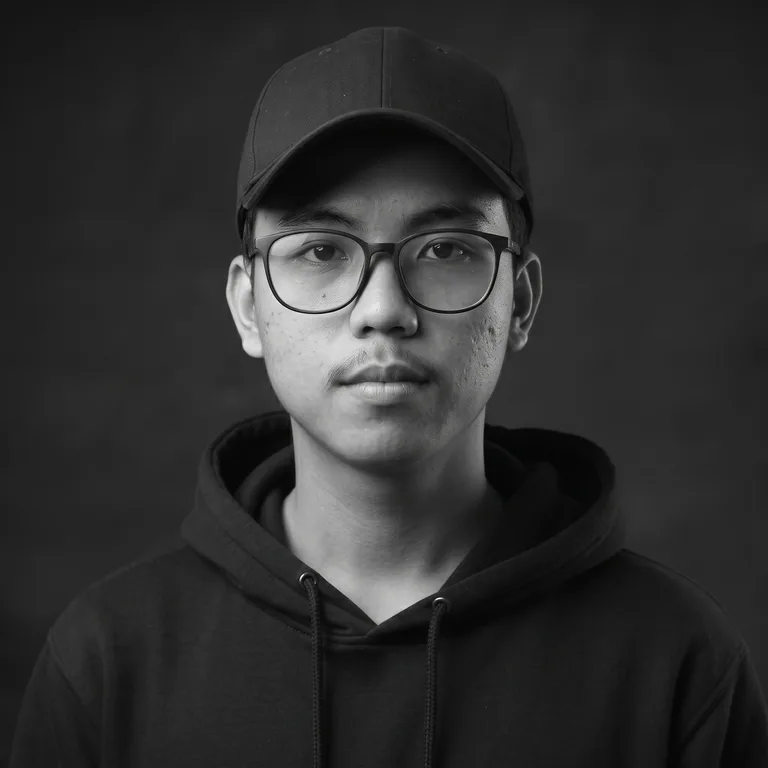
Muhammad Alif
Open Source Developer based in Makassar, Indonesia.
I build things, publish most of them openly, and keep the record here. Usually it starts as a question I want answered.
The work is mostly open source projects, automation, and the parts of tech and AI that turn an idea into something that runs.
This page is the longer version. Where the interest came from, and what I think makes software worth building.
01 / Curiosity
It started with wanting to know how a website worked.
Around junior high school I got properly online for the first time. What held my attention was not any particular site but the gap between what showed up in the browser and whatever was producing it.
So I asked the obvious follow-up questions. How is this made? What is underneath it? Could I make one? The answers arrived slowly and mostly by breaking things. Static pages first, then pages that did something, then small tools that made sense to nobody but me.
Later there was freelance work, client projects, paid side work, and a long tail of experiments that went nowhere. Somewhere in the middle of it, building stopped being a question I was answering and turned into a habit I kept. None of it followed a syllabus. I learned things in the order curiosity happened to point.
- 01Found the internetNo idea how they worked
- 02Asked howThe question that stuck
- 03Built somethingBadly, at first
- 04Broke itThen read about why
- 05Tried againRepeatedly
- 06Made something usefulSmall, but it worked
Writing the code is one slice of it. The parts that hold me are earlier and later: working out what is worth building, redrawing an interface until it stops feeling awkward, wiring together two systems that were never meant to meet.
02 / Building Things
The part I like is rarely just the implementation.
- 01BrainstormingDeciding what should exist
- 02Problem SolvingFinding the version that works
- 03InterfacesMaking a system legible
- 04New StacksTrying the unfamiliar one
- 05AutomationRemoving work I have already done
- 06AIThinking out loud, faster
- 07Open SourcePublishing what holds up
- 08SystemsGetting separate parts to agree
Lately a lot of that has gone into automation and AI. I use models to think out loud, to move faster through implementation, and to get a foothold in territory I do not know yet. Agentic workflows and harnesses like Hermes Agent are the current thing I am pulling apart. The tools will keep changing. The reason I reach for them does not.
Right now that mostly means automation and agentic workflows: memory that survives a session, tools an agent can reach without me supervising every call, jobs that keep running after I close the laptop. Very little of it is settled yet, which is the part I like. I would rather be early and wrong than late and comfortable.
Open Source
Useful to me first. Public second.
Most of what I open source starts close to home. Something is annoying, I build the smallest version that fixes it, and then I actually use it. If it survives that, publishing costs almost nothing and gives the project a second chance: somebody runs into the same problem and finds it already solved.
I am not counting stars. A project does not need thousands of users before it has earned the right to exist. Sometimes the first user is me, and that is enough of a reason to build it. A few of those grow up into published projects with pages of their own.
- A problem I haveSomething keeps being annoying
- The smallest thing that fixes itNot the ambitious version
- Use it for a whileDoes it actually help?
- Publish the sourceCosts almost nothing
- Someone else has the same problemPossible, not required
03 / Digital Footprint
This site is a record of the work, not just a resume.
Work has a habit of disappearing into private repositories, old folders, chat threads, and posts that quickly fall out of reach. This site keeps my projects, articles, repositories, and unfinished experiments in one place I control, where they can compound into a record of what I made, what held my curiosity, and the writing that explains why I bothered.
Short for Al Developer, used across my open-source projects and published work.
- mhdalif.idWhere everything collects
- GitHubSource and experiments
- ProjectsWork with its own pages
- WritingArticles and notes
04 / Perspective
Complexity is interesting. It is not the point.
I like experimenting, which means I overengineer things, and not always by accident. Sometimes the complicated route is the reason I started, because the implementation itself is what I want to try.
A simple problem becomes a decent excuse to learn an architecture. That has a failure mode and I have hit it more than once. A project outgrows the problem that started it. Scope drifts until the finish line moves out of range.
Some of those are still sitting unfinished, and I have made a kind of peace with it: not every experiment is supposed to survive. What I keep landing on is that the complexity has to be paid for by the result. A clever system nobody uses is a smaller thing than a plain one that does its job.
What pulls me in
- An unfamiliar stack
- Systems that interlock
- Automating something manual
- Pushing an implementation further
What settles it
- Does it solve the problem?
- Is it useful to somebody?
- Did it actually get finished?
- Was the complexity paid for?
The work is only part of the picture. Place, reading, music, and the things I keep returning to shape how I think long before anything reaches the editor.
05 / Beyond Software
Outside the editor.
- Home base
- Makassar, IndonesiaWhere the work begins
- Reading
- PhilosophyIdeas worth sitting with
- Alongside it
- PoetryLanguage beyond utility
- On repeat
- DandelionsRuth B.
I believe good software isn't only about complexity; it's also about being meaningful, purposeful, and genuinely useful.