For most of the time I have been building software, an idea only became real after I sat down in front of a computer. The process was predictable. I would get an idea, brainstorm it with ChatGPT, open VS Code and a terminal, initialize or revisit a repository, bring a coding agent into the workflow, explain the project context, review the implementation, push the result to GitHub, and eventually deploy it. Modern coding agents had already removed a significant amount of friction from programming itself, but the structure of the workflow had barely changed. The development workstation remained the center of gravity. Ideas could appear anywhere, but execution still waited until I entered the development environment.
Hermes Agent changed that relationship in a way I did not initially expect. I now run Hermes continuously on a VPS and use Telegram as my primary interface to it. When an idea appears, I no longer need to treat the absence of my primary computer as the boundary between thinking and building. I can describe what I want from my phone, provide a detailed project specification when the problem deserves one, let the agent operate inside the environment where the work actually lives, review what it produces, send revisions, and continue the development loop without first reconstructing the entire workstation ritual that used to sit between an idea and its implementation.
The important part, however, is not Telegram. Telegram is simply the interface I happen to use most often.
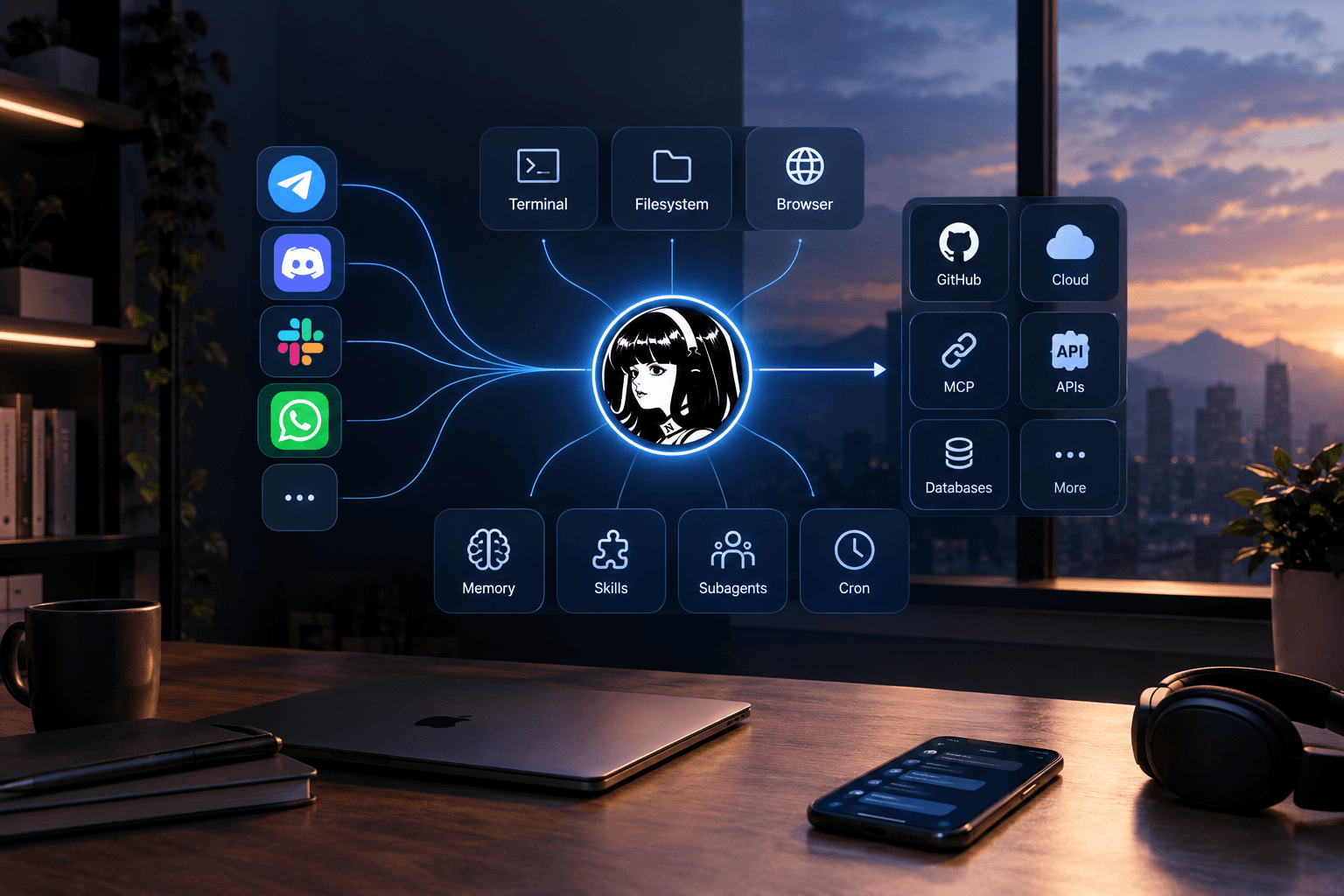
Hermes is designed around the agent itself rather than around one specific client. The same persistent runtime can be connected to messaging platforms and external systems such as Telegram, Discord, Slack, WhatsApp, and other services that expose suitable APIs or integration endpoints. That distinction matters because the real value is not that Hermes turns one messaging application into an AI client. The value is that the agent can remain continuously available while the human chooses whatever interface is most convenient for the situation.
A developer might use Telegram from a phone, Slack from a work environment, Discord inside a community workflow, a CLI while connected directly to the server, or another API-driven surface built specifically for an internal system. The interaction point can change without changing where the agent lives or what it can do. The interface becomes interchangeable while the execution environment remains persistent.
That is where the life-changing part begins.
My previous workflow began at the workstation. With Hermes, the human-facing part can become dramatically shorter and begin from whichever interface is already convenient:
- ThinkIdeaBrainstorming with ChatGPT
- Set upVS Code & TerminalCoding Agent
- ShipRepositoryDeploy
- CaptureIdeaAny Interface
- DelegateHermesToolsEnvironment
- VerifyRepositoryTests
- DeliverGitHubDeploy
The improvement is not that a messaging application replaced an editor. The editor still exists, the terminal still exists, and I still use both regularly. The improvement is that they no longer have to be the starting point.
A Personal Agent Is More Than a Chat Interface
The easiest way to misunderstand Hermes is to describe it as a chatbot connected to Telegram, Discord, or Slack. Technically, a language model is involved and those platforms can be used as interfaces, but that description removes almost everything that makes the system interesting. Hermes is better understood as a persistent personal agent runtime that can remain active inside an environment with access to tools, files, commands, browser automation, external services, memory, reusable skills, Model Context Protocol integrations, scheduled tasks, and delegated subagents.
The messaging layer is simply one entry point into that runtime.
This distinction becomes clearer when comparing a conventional conversational AI system with an agentic one. A typical chatbot follows a relatively simple interaction pattern: a human sends a message, the model interprets it, and the model returns a response. Even when the answer contains code or technical instructions, the interaction often ends at the point where language has been generated. The human is responsible for moving that answer into the environment where something useful actually happens.
A persistent agent operates differently because the model can sit inside an execution loop. It can interpret the request, inspect the environment, decide which tool to use, observe the result, revise its plan, invoke another tool, recover from an error, and continue until the task reaches an acceptable state.
That architecture changes what an interaction with AI can represent.
Instead of stopping at a generated response, the interaction becomes a continuing execution system:
- Human
- Model
- Response
The difference is substantial because useful work rarely consists of producing one perfect response. Software development alone may require inspecting existing files, creating new modules, installing dependencies, running tests, reading failures, tracing logs, debugging unexpected behavior, modifying the implementation, rerunning the test suite, and revisiting earlier assumptions. Outside software engineering, the same pattern applies to research, automation, infrastructure management, content workflows, information gathering, recurring administrative tasks, monitoring, and many other activities where an answer is only one step in a larger process.
Hermes becomes powerful because it can participate in that process rather than stopping after generation.
Its capabilities are broad enough that describing it only as a coding agent would also be incomplete. The terminal and filesystem make software development possible, but the same runtime can browse the web, interact with remote services, call MCP servers, maintain persistent memory, load reusable skills, delegate independent work to subagents, execute scheduled tasks, and communicate through multiple gateway integrations. These components turn Hermes from a single-purpose development assistant into something much closer to a general-purpose personal agent.
The model provides reasoning. Hermes provides the environment in which that reasoning can become action.
The Interface Can Change Without Changing the Agent
One of the most important characteristics of Hermes is that the agent is not conceptually tied to the application through which I communicate with it. Telegram is simply my preferred interface because it is convenient, always available on my phone, and works naturally for an agent that is running continuously on a remote VPS. Another user could build an entirely different workflow around Slack, Discord, WhatsApp, a command-line interface, a custom dashboard, or another service with an API integration.
That separation has practical consequences.
If the agent were fundamentally a Telegram bot, its usefulness would begin and end with Telegram. If the agent is a persistent runtime with messaging gateways and extensible integrations, Telegram becomes just one presentation layer. The state, tools, memory, environment, scheduled tasks, and operational capabilities remain attached to Hermes rather than to the client.
This is similar to how a web application can expose the same backend through a browser, mobile application, API, CLI, or automation workflow. The backend remains the system of record while clients become different ways of interacting with the same underlying capability.
Hermes applies a similar idea to personal agents.
That is also why I do not think the most compelling description is "an AI bot in Telegram." The better description is an always-on agent that can be reached through Telegram.
The difference sounds semantic, but architecturally it changes everything.
Why It Feels Life-Changing
The feature list alone does not explain why Hermes feels different in daily use. Terminal execution, browser access, memory, skills, MCP, subagents, scheduled tasks, and messaging integrations are all valuable capabilities on their own, but the life-changing quality appears when they exist together inside one persistent system.
The agent is not limited to the moment when I actively open it. It can already be running before the idea appears. It can maintain access to the environment where projects live. It can remember useful context from previous interactions. It can reuse procedures it has learned before. It can invoke external tools. It can split a large task into delegated workstreams. It can execute scheduled jobs without waiting for a manual prompt. It can deliver results through the same communication channels I already use every day.
That combination significantly changes the activation energy required to start doing something.
An idea no longer has to survive until I have enough motivation to sit down at a computer, navigate to a repository, reconstruct the context, launch a coding agent, and begin implementation. A server issue does not always have to wait until I can SSH into the machine manually. A research question does not necessarily have to become a tab collection that I revisit later. A recurring task does not always require me to remember that it needs to happen.
The agent can become the first place where intent goes.
That may sound like a productivity improvement, but I think it is more fundamental than that. Productivity tools usually make an existing workflow faster. Hermes can change where the workflow begins.
The distinction matters because human motivation and attention are finite. Many ideas never become projects not because they are technically difficult, but because the friction between thought and execution is high enough that the moment passes. Persistent agents reduce that distance.
The result is not that everything suddenly becomes effortless.
The result is that more things actually get started.
OpenClaw Helped Popularize the Direction
OpenClaw deserves some context because it helped make the idea of an always-on, messaging-native personal agent significantly more visible. I never personally used OpenClaw in my own daily workflow, so I cannot honestly frame my experience as a migration story. What I can describe is the ecosystem I observed around these projects. By the time I started seriously exploring the category, Hermes was becoming increasingly visible in developer discussions, experiments, and self-hosted agent setups, and it was the project I kept seeing people build around.
That shift is worth discussing carefully because it would be easy to exaggerate it into a simplistic claim that Hermes replaced OpenClaw or that nobody uses OpenClaw anymore. That would not be accurate. OpenClaw remains an active project with its own community, architecture, integrations, and advantages. The more useful observation is that this category of software matured enough for migration between agent systems to become a real engineering concern. Developers started caring about persistent persona data, memory, reusable skills, messaging configuration, model providers, MCP integrations, workspace instructions, and the ability to move that state between runtimes.
Hermes eventually added an official migration path for OpenClaw users, which is revealing in itself. Migration tooling exists because the meaningful part of a personal agent is no longer just the model being used at a particular moment. The surrounding state has become valuable. An agent accumulates configuration, memories, procedural knowledge, messaging channels, provider information, and user-specific behavior that people increasingly expect to preserve when moving between systems.
That development marks a broader transition in how personal agents are being treated. The question is no longer simply whether an AI can answer messages through a messaging application. The more important question is what happens when the agent behind those messages has persistent access to an environment where it can actually perform work.
Hermes was the project that made me want to build around that idea.
The Important Breakthrough Is Not Code Generation
Coding agents are already capable of producing impressive amounts of software. Tools such as Claude Code, Codex-style agents, Cursor, terminal-based coding agents, and many other systems can inspect repositories, modify files, reason about bugs, understand architectural relationships, and complete development tasks that would have required considerably more manual effort only a few years ago. If Hermes only offered another path to code generation, it would be useful, but it would not fundamentally change my workflow.
The larger distinction is persistence combined with delegated execution.
A conventional coding agent is often something I deliberately open when I am ready to work. Even when the agent itself is highly autonomous, the human usually initiates the development environment first. Hermes reverses part of that relationship because the agent can already be running when the task appears. The environment is persistent, gateways remain available, and the execution context exists independently of whether my workstation is active.
That changes the order of operations. Instead of opening my development environment, selecting a repository, launching a coding agent, and then deciding what work should happen, I can decide what work needs to happen first and let the agent enter the environment on my behalf. The workstation becomes something I can join later for deeper review, manual debugging, architecture work, or direct intervention instead of something that must exist at the beginning of every task.
This is why the phrase "coding from Telegram" undersells the experience. The same problem would exist if I said "coding from Slack" or "coding from Discord." None of those interfaces is the point. I am not replacing VS Code with a chat box. I am moving the point at which human involvement begins.
The first interaction can happen before the editor, before the terminal, before the repository is open on my local machine, and sometimes even before a repository exists at all.
The underlying breakthrough is persistent delegated execution.
Hermes Has Enough Tools to Become a General Personal Agent
One of the reasons Hermes feels broader than a conventional coding assistant is the diversity of capabilities surrounding the reasoning model. Terminal access allows it to execute commands and interact directly with development environments. Filesystem tooling allows it to inspect, create, edit, and reorganize project state. Browser and web capabilities extend the environment beyond the local machine. MCP support allows additional external systems and APIs to become part of the agent's toolset without requiring every integration to be built directly into the core runtime.
Persistent memory adds continuity across sessions, while skills allow procedures and reusable workflows to become part of the agent's operational knowledge. Scheduled execution allows tasks to run in the future or on recurring cadences. Messaging gateways allow results and requests to move through different communication platforms. Subagents allow larger tasks to be decomposed into isolated reasoning contexts rather than forcing everything through one increasingly noisy conversation.
Each of these features could exist independently, but their combination creates something qualitatively different.
A personal agent can receive a task through one interface, recall relevant information from prior work, inspect the environment, use an external tool through MCP, delegate research to a subagent, execute commands, schedule follow-up work, and later deliver a result through a messaging channel.
That begins to resemble orchestration rather than conversation.
For developers, this naturally maps to repositories, servers, tests, deployments, APIs, and infrastructure. For non-technical users, the same architecture can map to research, information management, repetitive workflows, monitoring, summarization, reminders, and other tasks where the desired outcome matters more than the implementation details.
The more tools the agent can safely access, the less important it becomes for the user to manually navigate every application involved in the workflow.
Complex Work Can Start With Complex Prompts, but It Does Not Have To
My own prompting workflow is probably more detailed than what most people would consider normal. For serious software projects, I often write extensive specifications before asking an agent to implement anything. Those specifications can become Markdown files containing architecture decisions, implementation constraints, required behavior, security expectations, compatibility requirements, testing strategies, edge cases, operational assumptions, and explicit review criteria. Some of these files can reach thousands of lines.
I do this because complex engineering benefits from explicit contracts. The more authority an agent receives, the more useful it becomes to clearly define what success means. Ambiguity is expensive when a system can create files, install dependencies, manipulate infrastructure, and make architectural decisions on your behalf. Detailed specifications therefore remain valuable, especially when I care about maintainability, security, or compatibility with a larger system.
That workflow should not be mistaken for a requirement of Hermes itself.
One of the important properties of a tool-using agent is that the user does not need to describe every mechanical step required to reach the desired outcome. An agent can receive a relatively high-level instruction and discover part of the technical path through its environment.
A non-technical user could ask, "Check why my website is down and fix it." That request contains almost no implementation detail. It does not specify whether the problem comes from DNS, a reverse proxy, application code, a crashed process, an expired certificate, a failed deployment, or an external dependency. A capable agent can investigate those layers through tools. It can inspect process state, test network connectivity, read logs, examine configuration files, compare recent changes, and determine what failed before deciding how to act.
The same principle applies outside development. A user could ask the agent to research a topic, monitor an external condition, summarize recurring information, organize files, inspect a service, query an API, or execute a repeated procedure without knowing the implementation details of every step involved.
This does not mean prompt quality becomes irrelevant. Complex systems still benefit from precise instructions, and there is a meaningful difference between asking for an outcome and specifying the architecture you expect. The important shift is that the human no longer needs to encode the entire execution path into the prompt.
A traditional script requires the developer to know the steps in advance.
An agent can discover some of those steps dynamically.
ArchRouter Is the Best Example of What Changed for Me
The clearest example of this new workflow is ArchRouter, a project I created to provide headless control, automation, and lifecycle management around Hermes Agent and 9Router. The project is interesting to me not only because of what it does, but because of how it was created.
The idea came from me. The architectural direction came from me. The specification, requirements, constraints, review criteria, and revision requests came from me. Hermes performed the implementation work.
I did not begin by opening an editor and manually creating the project structure. I described what I wanted, prepared detailed instructions, let Hermes build the project from zero inside its environment, reviewed what it produced, identified problems or areas I wanted changed, and sent revisions back through the same agent workflow. Hermes handled the codebase, dependencies, implementation details, failures, testing cycles, and iterative changes required to turn those instructions into a functioning repository.
This is an important distinction because statements such as "AI built this project" can easily become misleading. ArchRouter is still my project. The problem definition, product intent, architecture, requirements, evaluation, and decisions are mine. Hermes acted as the execution layer that translated those decisions into software. In that sense, the relationship resembles delegation inside a conventional engineering organization. A technical lead does not stop being responsible for a system because another engineer implements it. AI changes the entity performing the implementation, but it does not remove the need for ownership, judgment, review, or direction.
What makes ArchRouter especially interesting as a case study is that the project extends the environment around Hermes itself. ArchRouter is not an inference proxy. It is a control and lifecycle layer that sits around Hermes and 9Router, providing operational capabilities such as health inspection, provider management workflows, model routing visibility, update checks, CLI operations, MCP exposure, and messaging-facing control flows.
Its management path is conceptually separate from inference. Operational control and actual model traffic follow different routes through the system:
That separation gives ArchRouter a specific responsibility. It manages the infrastructure around inference without pretending to be the inference layer itself.
The recursive quality of that architecture is what I find most interesting. I used Hermes to build tooling that gives Hermes more control over the model infrastructure surrounding it. Hermes did not rewrite its own source code, and ArchRouter should not be described as autonomous self-modification, because that would be technically inaccurate. What happened is more grounded and, in some ways, more useful: an agent participated in building the infrastructure that extends the environment in which that same agent operates.
That is the point where Hermes stopped feeling like a convenient coding assistant to me and started feeling like programmable infrastructure.
The Model and the Agent Are Separate Layers
My current Hermes workflow primarily uses GPT-5.6 Sol as the reasoning model, but Hermes itself remains a separate layer from the model. That distinction is easy to overlook because AI products are often discussed as though the model and the surrounding application are the same thing. In agent systems, they are increasingly different architectural components.
The model provides reasoning capability. Hermes provides the environment in which that reasoning can become action. It manages tool access, messaging gateways, execution context, memory, skills, delegation, scheduling, and the operational loop that connects model decisions to real systems. This separation is important because models change much faster than workflows do.
The strongest model available today may not be the strongest model six months from now. Different tasks may also benefit from different providers, context lengths, pricing structures, latency characteristics, or capability profiles. If the agent runtime is tightly coupled to one model provider, every change in model strategy can require a larger architectural change. If the runtime remains model-flexible, the reasoning layer can evolve while the surrounding environment stays relatively stable.
That idea is one of the reasons projects such as ArchRouter became interesting to me. Model routing and provider management become infrastructure concerns rather than decisions hard-coded into each individual interaction. The persistent parts of the system are the tools, environment, memory, integrations, gateways, operational policies, and workflow logic. The model becomes one replaceable reasoning component inside that system.
This is a more durable mental model for personal agents.
The intelligence can change.
The environment can remain.
Memory Makes the Agent More Valuable Over Time
Persistent execution becomes much more useful when the agent does not have to begin every session as though nothing has happened before. Hermes includes persistent memory mechanisms that allow useful information to survive across conversations and become available again when relevant. That information can include project context, user preferences, recurring decisions, environment details, or other facts that would otherwise need to be restated repeatedly.
The important distinction is that memory is not the same thing as active context. A long-running personal agent may accumulate a large amount of information over time, but injecting all of that history into every model call would create noise, waste context capacity, and eventually reduce reasoning quality. Persistent memory works because information can remain outside the current inference context until the system has a reason to retrieve it.
That changes the experience of using an agent over longer periods. Instead of each interaction being an isolated request, the system can preserve continuity about how projects are structured, which decisions were already made, which approaches failed previously, or how the user prefers recurring tasks to be handled. The agent does not need perfect autobiographical memory to become more useful. It only needs a reliable way to preserve and retrieve the details that matter.
Skills extend the same concept from factual knowledge into procedural knowledge. A memory can represent something the agent should remember. A skill can represent a reusable way of doing something. When an agent repeatedly encounters a workflow, solves a non-trivial problem, or discovers a reliable procedure, that operational knowledge can become reusable instead of being reconstructed from scratch every time.
The resulting progression is important. The first time an agent performs a task, it may have to investigate the environment and discover the correct approach. Later, it can remember useful facts from that experience. If the workflow becomes recurring, the procedure itself can be encoded as a skill and loaded again when relevant.
At that point, the system is doing more than preserving conversation history. It is accumulating operational knowledge about how work gets done.
That is one of the characteristics that makes the term personal agent meaningful to me.
Scheduled Work Changes the Meaning of "Always On"
An always-on agent becomes considerably more useful when it can do more than wait for incoming messages. Hermes supports scheduled execution, which means tasks can be configured to run later or recur without requiring the user to manually initiate the same workflow each time.
This extends the personal agent model beyond reactive interaction.
A reactive chatbot waits for a question. A persistent agent can also become proactive within explicitly defined boundaries. It can run recurring checks, generate scheduled summaries, inspect system state, perform maintenance workflows, monitor conditions, or execute other repetitive tasks and then deliver the result back through a configured messaging channel.
That capability matters because many real workflows are not spontaneous conversations. They are repetitive operational responsibilities. Developers repeatedly inspect deployments, monitor services, check repositories, review changes, or gather information. Non-technical users also have recurring tasks that involve searching, organizing, summarizing, comparing, or following up.
Scheduling allows those workflows to move from remembered obligations into delegated procedures.
The agent does not become autonomous in some unlimited sense. It still operates under the capabilities and boundaries it has been given. What changes is that human presence is no longer required at the exact moment when every action begins.
That is another reason persistence matters more than the specific chat interface.
The agent can continue to exist even when there is no active conversation.
Subagents Turn Context Into an Architectural Resource
Long-running agent workflows create a problem that becomes increasingly important as tasks grow more complex: context accumulation. A single agent investigating multiple independent problems can quickly fill its working context with terminal output, search results, failed hypotheses, temporary plans, implementation details, and historical observations that are no longer useful.
Hermes supports delegation to subagents, allowing parts of a larger task to be handled in isolated contexts. A parent agent can assign a specific investigation to a child agent, allow that child to operate independently, and receive only the useful result rather than inheriting every intermediate detail that produced it.
This pattern is useful for more than parallelism. It provides context isolation. One subagent can investigate an API integration while another examines a failing test suite and another researches an architectural alternative. Each task can accumulate its own local history without forcing all of that information into one shared reasoning environment.
The analogy to process isolation in conventional computing is useful. Separate processes do not need to share every internal state transition. They communicate through defined interfaces and exchange only the information required by the broader system. Subagents can provide a similar property for reasoning workloads.
As agents move from short question-answer interactions toward hours of execution, context stops being an invisible implementation detail and becomes an architectural resource that needs to be allocated deliberately.
MCP Makes the Tool Surface Expandable
Another feature that significantly increases the practical value of Hermes is support for the Model Context Protocol. MCP provides a standardized way for agents to discover and interact with external tools and resources, allowing the agent's capabilities to expand beyond whatever integrations are built directly into Hermes itself.
This matters because a personal agent becomes more valuable as it gains safe access to the systems that matter to the user. A developer may want access to infrastructure tooling, code repositories, databases, observability platforms, deployment services, or internal APIs. Another user may care more about documents, communication platforms, productivity tools, or external research systems.
Without a shared integration model, every additional capability becomes a custom engineering project. MCP reduces that friction by giving agents a common protocol for interacting with an expanding ecosystem of tools.
The result is that Hermes does not have to contain every capability internally.
It can become an orchestration layer around capabilities that exist elsewhere.
That modularity is important for long-term usefulness because the environment around the agent can evolve without requiring the core runtime to become an enormous monolithic application.
An Always-On Personal Agent Does Not Need an Expensive Server
My Hermes instance runs continuously on an Oracle Cloud Free Tier VPS. For my current setup, the server itself does not add a recurring hosting cost, and that detail matters because persistent personal agents can sound much more infrastructure-heavy than they actually need to be.
The VPS does not need to perform the language model inference locally. It does not need a large GPU or workstation-class hardware. Its primary role is persistence. It provides a machine where Hermes can remain running, where repositories and tools can exist, where messaging gateways can stay available, and where automation can continue independently of whether my primary device is online.
The reasoning model can still come from an external provider. That separates the compute requirements of the agent runtime from the compute requirements of the model itself. A relatively modest server can therefore act as the persistent operational layer while inference happens elsewhere.
This architecture makes the always-on agent model surprisingly accessible. What matters most for many personal agent workloads is not raw local compute, but a reliable environment that remains available. The server provides continuity. The external model provides intelligence. Hermes connects the two through tools and execution.
For my use case, persistence matters more than owning powerful hardware.
The agent does not need an expensive workstation to live on. It needs a stable place to exist.
The Real Improvement Is the Reduction in Activation Energy
The feature list explains what Hermes can do, but it does not fully explain why the workflow feels different. Terminal access, memory, skills, MCP, multi-platform messaging, scheduled execution, browser capabilities, and subagents are individually useful, but the more important effect appears when they are combined.
Every idea has activation energy. Before meaningful work begins, there are small barriers that need to be crossed. A development device has to be available. The correct repository has to be opened. The development environment has to be reconstructed. The coding agent needs context. The task needs to be explained. The relevant files have to be located. Dependencies may need to be installed. The user has to mentally transition from whatever they were doing into development mode.
None of those steps is difficult by itself, but together they create friction. Friction matters because technical creativity is often fragile. Small ideas get postponed because they do not seem important enough to justify opening a full development environment. Minor fixes accumulate. Experiments stay in notes. Interesting concepts disappear because the transition from thought to implementation feels larger than the idea itself.
A persistent personal agent compresses that distance. The task can enter the execution environment almost immediately after the idea appears. The implementation may still take time. The agent may still need to debug failures, run tests, revise its approach, or ask for clarification. Real engineering does not become instantaneous simply because the interface is convenient.
What changes is that the process can begin without waiting for the human to physically occupy the workstation.
That is a much larger productivity improvement than shaving a few seconds from code completion.
Momentum is often lost before implementation starts.
Hermes reduces the distance between intent and action.
More Authority Means a Different Security Model
The same properties that make persistent agents useful also make them fundamentally different from ordinary chatbots from a security perspective. A language model that can only generate text has a relatively limited blast radius. A personal agent that can execute commands, modify files, access repositories, interact with APIs, manipulate deployment environments, use credentials, or operate infrastructure has real authority.
Hermes includes multiple defensive mechanisms around that authority, including messaging authorization, command approval behavior, file-write protections, isolation features, credential filtering, context safeguards, and other security controls. Those protections are necessary because the system is designed to do more than produce suggestions.
They do not eliminate the underlying risk.
If an agent can execute commands, a bad decision can become a real command. If it can deploy software, a mistaken implementation can reach production. If it has access to credentials, those credentials become part of the threat model. If it can manipulate infrastructure, the consequences of an incorrect action extend beyond the conversation where that action originated.
The correct response is not to conclude that powerful agents should not be used. The better conclusion is that operational discipline must grow with agent capability. Principle of least privilege becomes more important. Credential hygiene matters more. Environment separation matters more. Review boundaries matter more. High-impact operations should receive stronger controls than low-risk tasks.
The more capable an agent becomes, the less appropriate it is to treat the system as "just AI chat."
Useful autonomy always comes with an authority model.
From AI Assistance to Persistent Delegated Computation
A large part of the AI development conversation still focuses on model capability. Can the newest model write better code? Can it solve harder benchmarks? Can it reason over a larger repository? Can it use a longer context window? Can it autonomously finish more tasks?
Those questions matter, but the larger architectural shift may be happening around the models rather than only inside them.
The emerging pattern is a transition from interactive AI assistance toward persistent delegated computation. A coding assistant usually exists inside a workflow that the human initiates. A persistent agent can own part of the workflow itself. It can remain available, receive instructions remotely through multiple interfaces, access tools, inspect the environment, preserve useful state, delegate work, schedule future actions, and continue execution independently of where the human happens to be.
That changes the role of the computer. Traditional personal computing assumes that the human interacts directly with applications and operating systems. Remote access changed where that interaction could happen, but the human still performed the operations. Personal agents introduce a different abstraction. Instead of remotely operating the computer yourself, you increasingly delegate intent to software already operating inside it.
The interface becomes natural language, but the consequences remain computational.
That difference is why Hermes feels more important to me than another productivity tool. It is not simply improving the interface to code generation. It changes the relationship between human intent, model reasoning, and the environment where actions happen.
Turning Ideas Into Reality
I still use my computer every day. I still open VS Code, inspect repositories manually, use terminals, read code, question architectural decisions, rewrite requirements, review agent output, and intervene when an implementation does not match what I intended. Hermes did not eliminate the development environment and it did not remove the need for technical judgment.
What it changed was the assumption that all of those things had to happen before work could begin.
ArchRouter is the clearest example of that change. An idea that previously would have required me to sit at a desk, prepare the environment, initialize the project, open a coding agent, transfer the necessary context, and begin implementation became something I could orchestrate remotely through Hermes. I created the idea, defined the architecture, wrote the requirements, reviewed the implementation, identified problems, and requested revisions. Hermes executed the work required to turn those decisions into a functioning project.
That relationship is increasingly how I think about personal agents.
They are not replacements for judgment. They are execution layers for it.
The future of software development may therefore be less about whether AI eventually writes every line of code and more about how much of the distance between intention and execution can be delegated safely. Models will continue to improve, coding agents will become more capable, and tooling will evolve, but the larger change may be that work no longer needs to begin at the workstation.
The same idea extends beyond software. If the agent can access the right tools, environments, APIs, data, and communication channels, then software development becomes only one category of work among many that can be delegated through the same runtime.
That is why "turning ideas into software" no longer feels broad enough to describe what Hermes changed for me.
Hermes made the larger possibility visible.
An idea can begin as a message, become a sequence of real actions inside a persistent environment, interact with external systems, create artifacts, modify infrastructure, schedule future work, and eventually produce something that exists outside the conversation where it started.
The workstation did not disappear.
It simply stopped being mandatory for turning an idea into reality.